Pages

Wednesday, July 24, 2013

Salaam Alaikum, eh?


One of the best sitcoms I've seen  in recent years is a Canadian import currently streaming on Hulu.com called Little Mosque.  This show ran for six seasons in Canada under the title Little Mosque on the Prairie.  If you're looking for a genuinely funny show that is simultaneously heartwarming, uplifting and politically incorrect, you should check out the first three seasons of Little Mosque.

The show takes place in the fictional town of Mercy, Saskatchewan and centers on the trials and travails of a small community of Muslims trying to maintain their beliefs and traditions in a pluralistic and largely secular society.  The writing is funny and the characters, both Muslim and infidel, are engaging and likable.

In the series opener, the Muslim community of Mercy have just taken a major step forward by renting space in the local Anglican church for use as a mosque and by hiring an imam to lead their congregation.  The imam, Amaar Rashid, is a young Torontoan who has just left a law practice to enter the clergy, as implausible as that may sound.

One of the community's leaders, Yasir Hamoudi, can best be described as culturally Muslim, having been raised in Lebanon.  His parents are thoroughly and devoutly Muslim but Yasir has embraced the Canadian dream, building his own contracting business and marrying a local woman Sarah.  Sarah Hamoudi converted to Islam from Anglicanism so that she could marry Yasir but her commitment to her adopted faith seems tenuous at times, even though she repeatedly claims to be a good Muslim.  The Hamoudis have an adult daughter, Rayyan, who is a physician.  Rayyan considers herself a liberated, progressive feminist yet she is one of the more devout members of the community, wearing a hijab and scrupulously adhering to Muslim traditions governing relations between the sexes.

Baber Siddiqui is a Pakistani immigrant who is one of the most religiously conservative members of the Mosque.  He is ready at an instant to offer judgment as to whether a given practice is properly Islamic or not.  He is frequently butting heads with the non-Muslim residents of Mercy as well as with those Muslims whose devotion to the faith he finds lacking, Imam Amaar included.

Rounding out the major Muslim characters is Fatima Dinssa, a Nigerian widow who owns and operates a cafe.  She leans to the traditionalist side although she is not nearly as strident about it as Baber.

The rector of the local church, and thus the Mosque's landlord, is Father Duncan Magee.  At first the Muslims fear that Magee would refuse to rent space in the church if he knew it was to be used as a mosque.  Yasir suggests that Magee be told the property is being used as office space for his contracting business.  The fact that Yasir's service to the community happens to result in free office space for him is not lost on his neighbors.  As it happens, Magee is perfectly happy to rent to the mosque and he and Amaar quickly become friends.  As the older and more experienced clergyman, Magee often offers helpful advice to Amaar, such as how to stretch the meager salary of a man of the cloth by visiting nursing homes where they provide complimentary meals from the cafeteria.

Mercy's mayor is Ann Popowicz, a self-absorbed amoral hedonist.   She is interested in cultivating good relations with the Muslim community because it means more votes at election time.  Sarah Hamoudi is Popowicz's press-secretary and general political advisor.

Local talk-radio host Fred Tupper has found the Muslim community to be a convenient foil for his daily rants attacking what he sees as strange and suspicious practices raising the specter of a terrorist cell in rural Canada.

None of these brief descriptions does justice to its subject.  All the characters are multi-layered with their own faults and foibles that either bring them down to earth or round off their rough edges.

For instance, Baber could have easily been written as a priggish foil, a sort of Savanarola in a shalwar kameez.  But his personal life deviates markedly from the strict practice of Islam that he advocates.  Baber publicly demands that Muslim women display modesty in dress and conduct, but he dotes on his teenage daughter Layla who is apparently Canadian-born and fully assimilated with her peers at school.  When she defies Baber, asserting that she will never wear the hijab, he backs down.  In one episode he decides to send her to an Islamic boarding school for girls to shield her from the attentions of her male classmates but he is distraught at the thought of her leaving and pounces on the first excuse to rescind his fatwa.

Fred Tupper's baseless conspiracy mongering is played up for ratings on his radio show but his private relationships are more complex.  The Muslims of Mercy seem to accept Fred for who he is and manage to get along with him on a one-to-one basis.  When Layla Siddiqui got a job as Fred's intern, Fred's concern for her feelings caused him to tone down his anti-Muslim rants and his ratings tanked.  Layla sees what is happening and quits so that he can get back to what he does best.  She tells him, "[W]hen you get to know people you start to see them as individuals, and it starts a process of understanding, which builds bridges between cultures, which, in your line of work, is a real bad idea."  Fred also has a not-so-secret crush on Fatima.

I mentioned the show is politically incorrect.  When I first encountered it I feared it would feature a good deal of multi-cultural haranguing as the misunderstood and mistreated Muslims tried to educated the benighted rural (i.e. white) boobs who traffic in every racial and religious stereotype imaginable.  But there is none of that.  To the extent that there is cultural misunderstanding and conflict between the Muslims and their neighbors, the show finds responsibility on both sides.

When Amaar plans an open house to improve the mosque's relations with the community at large, Baber has trouble getting with the program:
Baber: Brother Amaar, I thought we could teach the infidels a little bit of Arabic.
Amaar: Before the open house on Sunday could you find a better word than "infidels?"
Baber: How about "heathens?"
Amaar: No.
Baber: "Crusaders"
Amaar: No
Baber: "The faithless"
Amaar: Keep trying.
Baber: Okay I'll come up with something.
Little Mosque doesn't dwell on the issue of terrorism but it does come up and the writers know how to play it for laughs.  In one episode Baber says that he is unable to attend an academic conference in the U.S. because he's on the "no-fly" list.  Amaar and Rayyan go with him to the U.S. Consulate to fight the good fight on behalf of a Muslim unjustly slandered as a terrorist.  This episode could have been a predictable rant about the arrogant overreaching American government.  But the writers of Little Mosque seem more interested in laughs than in politics and the show is better for it.

Political incorrectness is particularly surprising in a Canadian show.  Canada doesn't have a First Amendment but it does have a Human Rights Commission which can impose severe penalties for offending the wrong people.  Perhaps the writers, being Muslim, have joke telling immunity.

What I realized after a few episodes is that, even though this show is about Muslims, I recognized all these people from church.  Like the Muslims of Mercy, Saskatchewan, Christians in the west walk a tightrope between eternal truths and values and a modern culture that seems to reject those concepts.

At the beginning I mentioned I am recommending the first three seasons.  Beginning with season four the show's creators introduced the first genuinely unlikable character in the person of Father William Thorne, Magee's replacement as rector of Mercy Anglican.  Thorne is close-minded, self-centered, scheming, arrogant, disingenuous and contemptuous, not just of his Muslim tenants but of his own congregants.  Thorne aspires to a more prestigious posting than the rustic parish of Mercy, Saskatchewan and despises the unsophisticated flock he is forced to tend.  In bringing Thorne into the show the creators destroyed the chemistry that made the show such a joy to watch.  I suggest watching seasons four through six only if you're an obsessive compulsive that has to finish the series or if you are genuinely interested in the soap opera plot line that runs through most of the seasons.

Saturday, April 20, 2013

Not So Fast

Dzhokhar Tsarnaev has been in custody less than twenty-four hours.  From what has been publicly reported there is very little information about with whom he conspired, other than his late brother, in carrying out the Boston Marathon bombings earlier this week.  It is also apparent, again based on public reports, that he is in no condition to answer questions.  Yet a chorus of politicians and media figures are clamoring for him to be designated an enemy combatant so that he can be held without trial and interrogated without legal representation or even being informed of his constitutional rights.

To me these demands smack of appeasing a vengeful mob rather than the serious dispassionate consideration this issue requires.  The practice of treating captured terrorists as enemy combatants dates back to the Congressional Authorization for the Use of Military Force (AUMF) passed in the wake of the September 11 attacks.  The heart of the AUMF is this statement:
[T]he President is authorized to use all necessary and appropriate force against those nations, organizations, or persons he determines planned, authorized, committed, or aided the terrorist attacks that occurred on September 11, 2001, or harbored such organizations or persons, in order to prevent any future acts of international terrorism against the United States by such nations, organizations or persons.
This language takes a certain class of individuals, those involved in planning, authorizing, committing or aiding the September 11 attacks, out of the purview of law enforcement and places them under military jurisdiction.  Consequently, those individuals may be held by the military as prisoners or detainees until such time as hostilities are ended.  Those persons who come into U.S. custody who are not lawful combatants as defined by the Geneva Conventions are not entitled to the protections those Conventions afford to Prisoners of War.

This has placed the detainees taken by the U.S. in a very bleak situation.  This is not a conventional war that will be concluded at some time with an armistice, a peace treaty or a surrender.  There is no readily identifiable end to this war.  There is no apparent means of even tracking its progress.  Basically it will end when Congress decides the Al Qaeda threat has diminished to a point that it no longer merits a military response.  So the detainees, chiefly those at Guantanamo Bay, face a long indefinite imprisonment that may or may not involve a trial at some point.  During their detention they do not enjoy the rights afforded to privileged belligerents.  They wear orange jumpsuits instead of their own clothing; they are housed in cells rather than barracks; they are subject to coercive interrogation and may not fall back on disclosing only name, rank, service number and date of birth.

Nevertheless, if their situation is bleak, it is their own fault.  Al Qaeda started this war.  The United States are merely attempting to apply the normal rules of warfare to a new and very different kind of conflict.

But we must remember that the right and the authority to treat members of Al Qaeda and its affiliates in this fashion derives from Congressional legislation.  Congress alone has the power to declare war.  And although the AUMF never uses those words, it is, in effect, a declaration of war.  The question is: does Dzokhar Tsarnaev come within the application of the AUMF?  I think it's premature to make that determination.

Just because Tsarnaev was apparently motivated by Islamic fanaticism, that doesn't make him associated with the perpetrators of 9/11.  Yes, the Tsarnaev brothers frequented jihadist web sites and posted incendiary videos to YouTube.  But that only proves that they were inspired by the jihadist ideology.  Unless there was two-way communication with Al Qaeda affiliated organizations, it doesn't seem like the case can be made that they come within the purview of the AUMF.  The older brother, Tamerlan, traveled to Russia for six months.  I don't think we can just assume he went to meet and/or train with jihadist forces.  He might have been visiting family.  He might even have gotten training and instruction from Chechen nationalist terrorists and then applied his new found knowledge to advance his own personal jihad.  But even that would not make him an enemy combatant under the AUMF.

So why the rush?  There is probably a certain amount of grandstanding and chest thumping.  People understandably want to throw Tsarnaev into the deepest darkest hole in Gitmo, at least until he can be properly executed.  There may be a certain amount of embarrassment on the part of the Obama administration over getting caught flatfooted and completely unawares by two nobodies.  But we must remain a nation of laws.  If a connection to a larger organization with 9/11 ties can be proven than by all means hand Tsarnaev over to the military.  If, however, these two acted alone, maybe using Islamism to give meaning to a personal sense of failure and despair, then Tsarnaev should be handled by the criminal justice system, just like Tim McVeigh, Eric Rudolph and Ted Kaczynski.

Wednesday, March 6, 2013

Why Rand Paul is Wrong

Embedded image permalink

I'm a big fan of Sen. Rand Paul (R-KY).  He's one of the few persons holding federal office today who didn't perjure himself when he swore to uphold the Constitution.  Conversely I am absolutely not a fan of Barack Obama.  I don't like him at all and  I think he holds the Constitution in utter contempt.  But Sen. Paul is just wrong in his demand that the President forswear the authority to use deadly force, as part of a Congressionally authorized military action, against any enemy of the United States anywhere in the world, whether that enemy be a U.S. citizen or not and whether he be within the United States at the time or not.

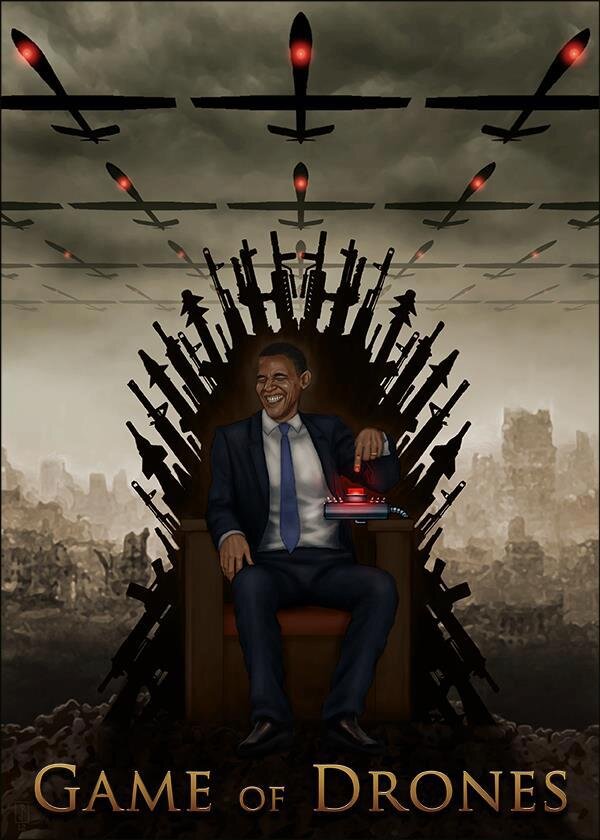
Sen. Paul has begun a filibuster to prevent the confirmation of John Brennan as Director of Central Intelligence over the issue of using military force, specifically drone strikes, against U.S. citizens within the boundaries of the United States as part of the Global War on Terror (GWOT).  He is raising the specter of Hellfire missiles slamming into coffee shops, bombs falling on restaurants and Americans being killed while they sleep in their bedrooms.  He is arguing that U.S. citizens are entitled to due process, including some form of judicial review, before they can be targeted by the U.S. military.  In this he is misguided.

The critical legal fact is that the United States are at war with Al Qaeda and its affiliates.  Congress effectively declared war with the Authorization for the Use of Military Force (AUMF) enacted in 2001.  The act was not titled "Declaration of War," perhaps because in international relations the word "war" has largely been replaced by various euphemisms and perhaps because a Declaration of War might suggest Al Qaeda is a lawful belligerent.  Nevertheless Congress' intent was clear and there is no cause to believe the Constitution requires Congress to use any particular magic words in exercising its authority.

Congress declares the war, but the President runs it.  He is Commander in Chief of the armed forces.  When the United States are at war, the military, under the President's direction, is authorized to use all force, consistent with the laws of war, against the military forces of the enemy, including all people who are members of those forces.  The fact that a member of the enemy's military might be a U.S. citizen is irrelevant.  U.S. citizens fought with the Axis powers during World War II and they were legitimate military targets.  At least one of the German saboteurs who infiltrated the United States in 1942 was a U.S. citizen and he was treated the same as his comrades - tried by military commission and executed in the electric chair.  It is the U.S. government's position (though not mine) that every soldier in the Confederate Army was a U.S. citizen yet the U.S. military killed them by the thousands without any judicial review.

Of course the GWOT is different from those examples.  Nazi Germany and the Confederate States of America were identifiable political entities with publicly acknowledged governments and established military organizations occupying defined geographical boundaries.  Their soldiers wore uniforms and carried arms openly.  Even the German saboteurs, though they acted clandestinely, did so on behalf of the German government as part of its war against the United States.  The current enemy is far harder to pin down.  Al Qaeda has published no organizational chart indicating who is and is not part of its military effort against the United States.  To compound the difficulty, Al Qaeda regularly spawns regional affiliates in different parts of the world.

So identifying the enemy has become far more difficult than it has been in previous wars.  But that task is the responsibility of the military under the direction of the President.  To give any other branch of government a veto or other form of prior restraint over operational military decisions would be a serious breach of the separation of powers.  Which is not to say that there are no checks on the President's power.  At a minimum there is a political cost to be paid for abusing the war power to target non-combatants of any nationality.  And there is nothing preventing Congress from examining the President's use of his authority after the fact.

Can the President abuse his power by ordering a strike that is completely outside the scope of his Congressionally defined authority?  Theoretically yes, but frankly many of the scary hypotheticals posited by alarmists sound like paranoid fantasies.  Remember the President doesn't pull the trigger himself.  He acts through subordinates, each of whom is legally and morally accountable for his actions.  Members of the military are taught from their first days in training that they are obligated to disobey unlawful orders and they can be prosecuted if they don't

So we should consider the President's drone policy in the context of the current situation and recent history.  Nothing suggests that the more extreme fears of Rand Paul and his fellow critics are warranted.  If there is a problem with the President's use of drone strikes, it's that he uses them to kill Al Qaeda figures instead of taking them alive because he doesn't want to address the issues of detention, interrogation and military commissions.  Consequently he might be unnecessarily foregoing the opportunity to acquire valuable intelligence.  But Sen. Paul, who I believe genuinely respects the Constitution, should consider the implications of interfering with the President's authority.

Sunday, February 24, 2013

Boris and Natasha Join the PTA

My favorite new show is The Americans, Wednesday nights at 10 on FX.  The Americans are Philip and Elizabeth Jennings, a middle-aged, middle-class, middle-American couple living in the Virginia suburbs outside Washington, D.C.  They have a thirteen-year-old girl Paige who is just discovering clothes and boys and a ten-year-old boy Henry who plays hockey.  They go to the mall and to school plays.  They drive a four-year old Oldsmobile sedan.  They would be the most boring couple on episodic television since Ozzie and Harriet but for one fact - they are also Soviet spies.

The series opens in 1981.  Ronald Reagan has just been inaugurated president and the Soviet government wants to know about his plans to rebuild America's military strength and to take a generally more assertive posture against the Communist bloc.  The Jennings are agents of a highly-classified division of the KGB called Directorate S.  Directorate S trains deep-cover illegals to infiltrate U.S. society and establish themselves as sleeper agents.  Of course, the viewer knows something that the Jennings don't - the Soviet Union has not ten years of life left.  Perhaps it is appropriate that, in their cover lives, Philip and Elizabeth work for another doomed institution - a travel agency.

Of the two, Elizabeth is definitely the more committed.  She can seduce, she can kill, she can assume any role or play any emotion in the furtherance of her mission.  But in private she seems emotionally dead, motivated only by service to the Soviet state.  She's had two children with Philip but she doesn't seem to love him and, at times, appears to hold him in contempt.  Through a series of flashbacks we are acquainted with the events and forces that have shaped Elizabeth.  She was born Nadezhda which, somewhat ironically, means hope.  Her father was killed at Stalingrad when she was two years old.  In one scene her mother refuses a gift of food from a local party official, explaining that he would have expected something in return.  Her mother warns her that she must never rely on anyone but herself.  In training she was raped by one of her instructors.  Her "husband" was chosen for her by the KGB and she was instructed to have children to support her cover identity.

Philip is equally proficient and deadly at the craft of espionage but he also genuinely loves Elizabeth and his children and thoroughly enjoys living the life of an American husband and father.  As of the fourth episode we still know almost nothing of Philip's back story but he seems far better adjusted than his wife.  For him espionage seems to be just a job, little different from his work booking hotels and flights for his clients.  He doesn't take the Cold War personally the way Elizabeth does.  As a result, he often thinks more clearly and more realistically.  The most recent episode involved the shooting of Ronald Reagan by Hinckley and Philip is the only Russian who realizes that fears of a Haig-lead coup d'etat are overwrought.

Although Elizabeth appears to be without psychological or emotional weaknesses, such appearances are deceiving.  In Game of Thrones Cersei Lannister advises her would-be daughter-in-law not to love anyone because each love is a weakness that can be exploited.  Nevertheless, she says, a mother will always love her children and that is unavoidable.  So it is with Elizabeth.  Nothing comes before her devotion to the Motherland except her children.  When it appears the FBI might be closing in, Elizabeth fears neither death nor imprisonment, only that her children might come to despise her for deceiving them all their lives.

Philip lacks Elizabeth's fanaticism as well as the animosity towards America that it inspires.  So he seeks to protect his family from the threat of discovery by coming in from the cold.  He proposes to Elizabeth that they give themselves up to the FBI and surrender the defector they've got tied up in the trunk of their car in exchange for a lucrative bounty and a new life somewhere in America.  Philip is seconds away from carrying out his plan when he finds out that the defector is the instructor who raped Elizabeth during training.  He kills the defector without hesitation and the two of them dispose of the body.  Philip's decision to exact justice for his wife's attack instead of pursuing his dream of the good life in America moves Elizabeth and begins to inspire in her a loyalty and affection towards him and she ends up lying to her KGB superior, attesting to Philip's reliability, revealing nothing about his attempted defection.

The idea of building a series around two protagonists who are KGB agents predictably set off alarm bells with Newsbusters and other conservative web sites.  Suspicions were naturally raised that left-wingers in Hollywood would depict Reagan and the United States as dangerously aggressive, upsetting the detente so carefully constructed during the seventies.

But despite the setting, the show isn't really about politics.  It's about family and loyalty.  Philip and Elizabeth are the kind of complex antiheroes that are the staple of FX dramas like Rescue Me, Sons of Anarchy, and Justified.  We root for the Jennings not because we want them to win the Cold War, we want them to find a way out and have a normal family and a normal life.

And that is what ultimately makes The Americans an anti-Communist production.  Marx and Lenin predicted that class-solidarity would replace bourgeois institutions like the family.  The Bolsheviks made a martyr out of Pavel Morozov, a boy who, according to legend, ratted out his father to the secret police and was subsequently murdered by relatives.  The lesson is that loyalty to the state comes before family.  The Jennings demonstrate that totalitarian ideologies that seek to supplant the family are ultimately destined to fail.


Friday, January 25, 2013

Women in Combat

Leon Panetta's announcement that the Defense Department would shortly eliminate all rules preventing women from serving in front-line combat roles has provoked comments from all over the political spectrum revealing just how much we don't understand about human nature, the role of the military and the nature of modern war.  I expected this from the left but a surprising amount of it has come from the right.  Panetta's policy change is a dangerous innovation that deserves far more skepticism than it has received.

The argument most often heard in favor of removing restrictions on women in combat is that the restrictions limit women's opportunity for advancement, particularly in the officer corps.  This is the kind of attitude that one would expect to become prevalent during times of peace when even military life can devolve into a complacent routine that fosters the development of careerism.  It's dismaying to see this kind of argument given credence at a time when American forces are still at war in Afghanistan.  The military exists to support American policy and interests with the use or threat of use of force, not to provide a fulfilling and satisfying career path to anyone, man or woman.

In the days since the announcement I have seen the issue debated a number of times on television and the internet.  Very rarely does anyone object to the proposal itself.  Even on the right, commenters frequently approve of putting women in front-line combat roles provided, of course, that physical standards are not lowered to accommodate them.  Their left-wing interlocutors agree and reassuringly predict that women will have to meet the same standards as men in order to qualify for combat units.  Conservatives also occasionally caution that the presence of women in combat units might have a distracting psychological impact upon their male comrades-in-arms whose chivalric instincts might lead them to protect the women, to the detriment of the mission and the overall safety of the unit.  But this possibility does not concern them enough to make them oppose the policy outright.

As I said before, I think this is a bad idea for two main reasons.  Firstly, it's unrealistic to think that physical standards will not be lowered or that women will be treated the same as men in general.  I will discuss this in more detail below.  But even if we could be assured that the military would not relax its standards, there are adverse psychological effects that cannot be ignored.

Military training and tradition are designed to encourage a bond between warriors commonly referred to as "unit cohesion."  The Greeks, who had at least four different words for "love," would call the bond between unit members philia, or brotherly love.  Philia is inclusive and outward looking.  It encourages those who share it to support each other in pursuit of the common good.

Armies going back to ancient times have recognized the critical role that unit cohesion plays in maximizing the combat effectiveness of a force, even more critical than the martial prowess of the individual soldier.  The barbarian tribes of Europe produced outstanding fighters.  It used to be said that one barbarian could defeat ten Roman legionnaires; but that one thousand Romans could defeat ten thousand barbarians.  The difference was the training and discipline that formed Roman soldiers into cohesive units that were far stronger than the sum of their parts.

Unit cohesion has played a key role in many battles where small disciplined forces outfought far more numerous foes: the Greeks at Thermopylae and the British at Rorke's Drift are but two.  The nation of Israel has survived to this date only because the esprit de corps and training of their forces have more than compensated for the overwhelming numerical superiority of the armies arrayed against them.  Perhaps Napoleon put it best when he said that "in war moral power is to physical as three parts out of four."

The introduction of women (or gays for that matter) into the unit risks the development of romantic love, or eros as the Greeks would call it.  Eros is exclusive and discriminatory.  Partners in a romantic relationship naturally favor each other over those around them.  This creates a disruption in unit cohesion that can be fatal under combat conditions.  Try to imagine an infantry squad or platoon containing a romantically-linked pair, possibly with one or more rejected suitors.  The possibilities should give us pause considering that lives are at stake.

Another factor that can damage unit cohesion is the notion that one or more members of the unit are not pulling their weight or are otherwise receiving special treatment.  Most people I have heard discussing this issue have taken it for granted that standards, physical and otherwise, must not be compromised to accommodate the entry of women into combat units.  And no doubt the authorities will assure the public that no such reduction of standards is contemplated.  But history is not encouraging in this regard.  The fact is that throughout the armed forces men are held to higher physical standards than women.

In many cases this is not a serious issue.  There are many jobs within the military and not all of them subject the member to the same degree of physical stress.  The U.S. military includes the army ranger hiking the mountains of Afghanistan, but it also includes the airman moving cargo with a forklift and the navy yeoman making sure that every sailor on his base receives his full pay and benefits.  But at the tip of the spear, that infantryman in direct contact with the enemy, the environment is harsh and unforgiving.  And no matter how hi-tech the military has become, war is still an endurance contest.  In fact, advances in technology have done much to increase the effectiveness of the infantryman but they haven't really eased his burden.

But several commenters, with little or no direct knowledge of the military, have implied that modern warfare is somehow less physically demanding than in the past.  Juan Williams made some vague comment about how "it's all computers" now.  Even Charles Krauthammer, normally quite sensible, said that we're not talking about Agincourt and that our soldiers don't have to wear chain mail.  Charles obviously hasn't heard that the modern infantryman's kit, particularly when dismounted, weighs more than a medieval suit of armor.

The brutal truth is that an infantryman's survival depends on his ability to carry more - more ammunition, more armor, more water, more rations, more medical supplies.  If technology makes any of this stuff lighter, than that just means the soldier can carry more of it.  I'm sure no soldier wants to find himself at the mercy of the enemy because he didn't bring enough ammo with him.  Sadly I think that if this policy change goes forward, there will be pressure from people with little understanding of the requirements of combat to alter standards to allow for greater female participation in front-line units.