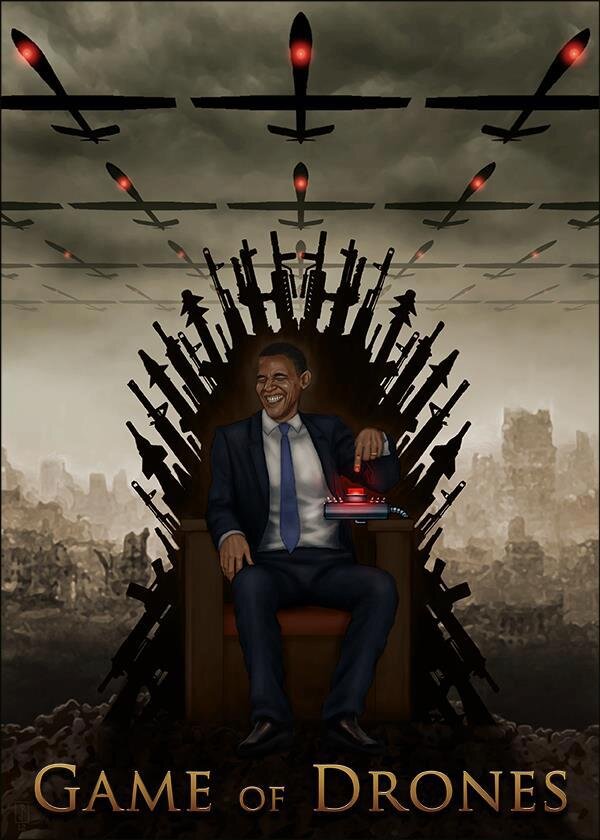
I'm a big fan of Sen. Rand Paul (R-KY). He's one of the few persons holding federal office today who didn't perjure himself when he swore to uphold the Constitution. Conversely I am absolutely not a fan of Barack Obama. I don't like him at all and I think he holds the Constitution in utter contempt. But Sen. Paul is just wrong in his demand that the President forswear the authority to use deadly force, as part of a Congressionally authorized military action, against any enemy of the United States anywhere in the world, whether that enemy be a U.S. citizen or not and whether he be within the United States at the time or not.
Sen. Paul has begun a filibuster to prevent the confirmation of John Brennan as Director of Central Intelligence over the issue of using military force, specifically drone strikes, against U.S. citizens within the boundaries of the United States as part of the Global War on Terror (GWOT). He is raising the specter of Hellfire missiles slamming into coffee shops, bombs falling on restaurants and Americans being killed while they sleep in their bedrooms. He is arguing that U.S. citizens are entitled to due process, including some form of judicial review, before they can be targeted by the U.S. military. In this he is misguided.
The critical legal fact is that the United States are at war with Al Qaeda and its affiliates. Congress effectively declared war with the Authorization for the Use of Military Force (AUMF) enacted in 2001. The act was not titled "Declaration of War," perhaps because in international relations the word "war" has largely been replaced by various euphemisms and perhaps because a Declaration of War might suggest Al Qaeda is a lawful belligerent. Nevertheless Congress' intent was clear and there is no cause to believe the Constitution requires Congress to use any particular magic words in exercising its authority.
Congress declares the war, but the President runs it. He is Commander in Chief of the armed forces. When the United States are at war, the military, under the President's direction, is authorized to use all force, consistent with the laws of war, against the military forces of the enemy, including all people who are members of those forces. The fact that a member of the enemy's military might be a U.S. citizen is irrelevant. U.S. citizens fought with the Axis powers during World War II and they were legitimate military targets. At least one of the German saboteurs who infiltrated the United States in 1942 was a U.S. citizen and he was treated the same as his comrades - tried by military commission and executed in the electric chair. It is the U.S. government's position (though not mine) that every soldier in the Confederate Army was a U.S. citizen yet the U.S. military killed them by the thousands without any judicial review.
Of course the GWOT is different from those examples. Nazi Germany and the Confederate States of America were identifiable political entities with publicly acknowledged governments and established military organizations occupying defined geographical boundaries. Their soldiers wore uniforms and carried arms openly. Even the German saboteurs, though they acted clandestinely, did so on behalf of the German government as part of its war against the United States. The current enemy is far harder to pin down. Al Qaeda has published no organizational chart indicating who is and is not part of its military effort against the United States. To compound the difficulty, Al Qaeda regularly spawns regional affiliates in different parts of the world.
So identifying the enemy has become far more difficult than it has been in previous wars. But that task is the responsibility of the military under the direction of the President. To give any other branch of government a veto or other form of prior restraint over operational military decisions would be a serious breach of the separation of powers. Which is not to say that there are no checks on the President's power. At a minimum there is a political cost to be paid for abusing the war power to target non-combatants of any nationality. And there is nothing preventing Congress from examining the President's use of his authority after the fact.
Can the President abuse his power by ordering a strike that is completely outside the scope of his Congressionally defined authority? Theoretically yes, but frankly many of the scary hypotheticals posited by alarmists sound like paranoid fantasies. Remember the President doesn't pull the trigger himself. He acts through subordinates, each of whom is legally and morally accountable for his actions. Members of the military are taught from their first days in training that they are obligated to disobey unlawful orders and they can be prosecuted if they don't
So we should consider the President's drone policy in the context of the current situation and recent history. Nothing suggests that the more extreme fears of Rand Paul and his fellow critics are warranted. If there is a problem with the President's use of drone strikes, it's that he uses them to kill Al Qaeda figures instead of taking them alive because he doesn't want to address the issues of detention, interrogation and military commissions. Consequently he might be unnecessarily foregoing the opportunity to acquire valuable intelligence. But Sen. Paul, who I believe genuinely respects the Constitution, should consider the implications of interfering with the President's authority.

